January 26th, 2004
I was ranting at the office about how Kyan deserves a piece of my mind
(as an experiment, I’ve shaved two days of stubble in the direction
of the grain only, with the result being one day of stubble) when
Darryl pointed me to the Shaving Gallery’s
“Guide To Wet Shaving”. The most surprising detail is this:
The only way to avoid sensitive skin and ingrown hairs is by NEVER
shaving against the grain.
[…]
While it is possible to retrain beard hair, it is not possible unless
you resist the urge to shave too close, too soon. By tearing up against
the grain at any time, the hair will drop beneath the skins surface
thereby making the pore susceptible to bacteria, pollution and
irritation from shirt collars. Tiny crusts will form forcing the beard
hair to exit from underneath. Now we have acute directional growth and
a huge potential for coiling, hence a thick beard and/or ingrown hairs.
Zounds! The very activity which is undertaken to rectify the problem
in fact creates it!
…
Comments Off on “There’s a little black hair on my face today”
January 26th, 2004
Pictorial synopsis of Star Trek:
Nemesis. In case you didn’t see it, or would like to be reminded of
just how badly you had your intelligence insulted when you did
see it.
…
Comments Off on Pictorial synopsis of Star Trek:
January 26th, 2004
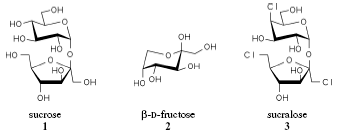
Fig. 1. Sucrose, fructose, and sucralose. [Immel,
1995, ch.
2 (PDF)]
Erin asked me some questions over the weekend about Splenda (the trade name for
sucralose) which my AP Chemistry couldn’t answer (such as, “but
why does it look like sugar to your tongue but not to your
enzymes?”). The Internet, as it turns out, is an interesting place to look
for information on food and drugs. A Google search for any kind of mildly
controversial substance (like sucralose or aspartame or DXM/dextromethorphan)
will return a result set that roughly matches the following:
| Toxicity paranoia: |
Fitness or cooking pseudoscience: |
Sales/marketing: |
Actual chemistry or pharmacology: |
| 50% |
25% |
25% |
0% |
The toxicity websites are most interesting to me. Some of it is not
paranoia but sound medical analysis
(as with dextromethorphan, or DXM, which is frequently abused by stupid
kids trying to get high from household products. Hey, stupid kids: Try
the Drano!). For sucralose, however, there are quite a few sites which
attempt to establish that we will all die, disfigured and in pain, if we
consume the stuff. Some of the reasoning is compelling,
and some is just absurd: (from holisticmed.com)
[…] The manufacturer claims that the chlorine added to sucralose is similar
to the chlorine atom in the salt (NaCl) molecule. That is not the case.
Sucralose may be more like ingesting tiny amounts of chlorinated
pesticides […]
Seriously, attempting to establish the potential toxicity of something
based on the presence of one (common, small) element is like trying to
establish that certain words shouldn’t be used because some of the
letters are vulgar. “Johnny, don’t say that!
It has the letter ‘K’ in it!”
So, BEWARE, unsuspecting consumers of Splenda™: it might be
poison because it contains the lethal element carbon
— a well-known component of CYANIDE!
…
Comments Off on Sucralose paranoia.
